
Using AI Brand Voice for Consistent Social Content
How teams keep tone consistent with Brand Kit rules and AI prompts.
Using AI Brand Voice for Consistent Social Content
Your audience follows you — not just your content. The moment your captions start sounding like a different person every week, trust quietly erodes. Here is how to use AI to scale your content without ever losing your brand voice.
Why Brand Voice Is Your Most Underrated Growth Asset
Most creators obsess over visuals, posting frequency, and hashtags. But the accounts that build the deepest loyalty — the ones with audiences that actually buy, refer, and come back — all share one thing: a recognisable, consistent voice.
Brand voice is not just tone. It is your word choices, your sentence rhythm, how you handle humour, how you open a caption, how you end one. It is the thing that makes someone read a post and think "that sounds exactly like them" before they even see the name.
When AI-generated content first took off, the biggest complaint was that everything sounded the same — generic, flat, robotic. That problem has not gone away on its own. It is solved by intentionally training your AI tools to understand your brand voice before generating a single word.
What Brand Voice Actually Means (With Examples)
Before you can teach your brand voice to an AI tool, you need to define it yourself. Most brands fall into one of these voice profiles — or a deliberate blend of two:
- Authoritative: Confident, data-backed, minimal fluff. Used by B2B brands, educators, and thought leaders. Sounds like: "Three things that separate growing accounts from stagnant ones."
- Conversational: Warm, casual, feels like a DM from a friend. Used by lifestyle creators, coaches, and personal brands. Sounds like: "Okay real talk — this is the caption mistake I see everywhere."
- Witty: Sharp, slightly irreverent, trusts the audience to keep up. Used by culture brands and entertainment accounts. Sounds like: "Another day, another algorithm change nobody asked for."
- Inspirational: Uplifting, forward-looking, emotionally driven. Used by wellness, fitness, and motivational brands. Sounds like: "You are not behind. You are exactly where your next chapter begins."
- Educational: Clear, structured, step-focused. Used by SaaS, finance, and creator economy brands. Sounds like: "Here is exactly how to write a caption that converts in 3 steps."
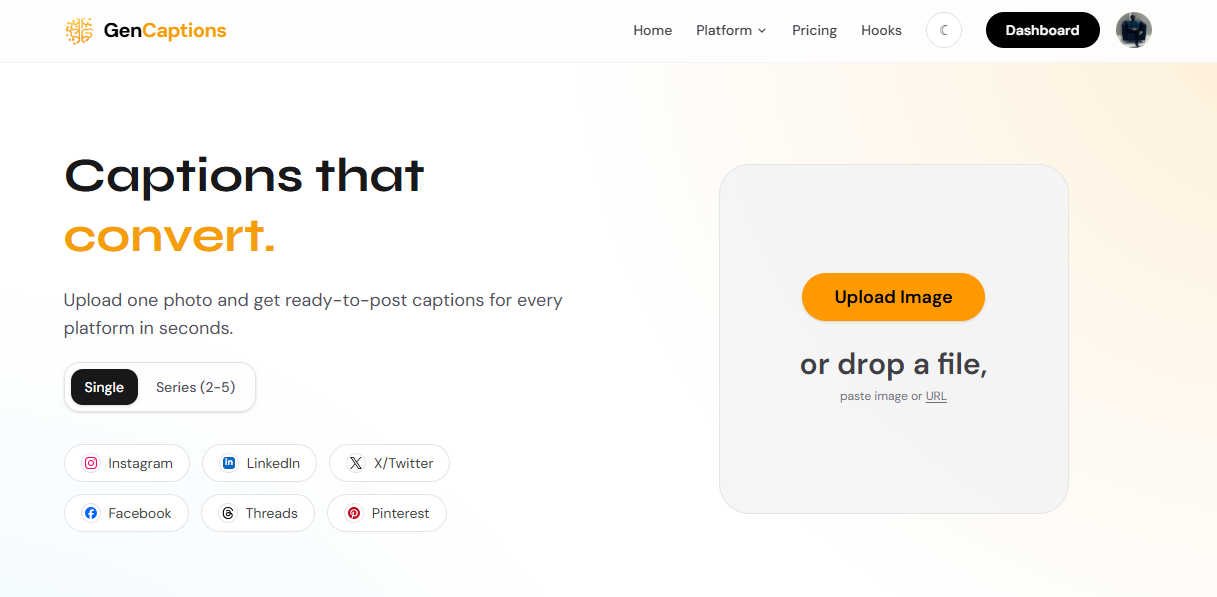
Step 1 — Feed GenCaptions Your Brand Context
The fastest way to get AI-generated captions that actually sound like you is to give the tool real context upfront. GenCaptions.com is built for exactly this — describe your niche, your audience, and the personality behind your brand before generating. The difference between a generic output and an on-brand one starts here.
How to Define Your Brand Voice in 3 Steps
You do not need a 20-page brand guideline document. You need three things:
- Pick 3 voice adjectives. Choose three words that describe how your brand sounds — not what it sells. Examples: bold, warm, nerdy. Playful, direct, premium. These three words become your filter for every caption you write or generate.
- Write 5 example captions from memory. Pull five captions from your best-performing posts. Read them aloud. What do they have in common? Sentence length? Humour style? How they open? That pattern is your voice.
- Define what you never say. Brand voice is as much about what you avoid as what you use. Do you never use corporate jargon? Never use exclamation points? Never use the word "journey"? Write it down. These guardrails keep AI output clean.
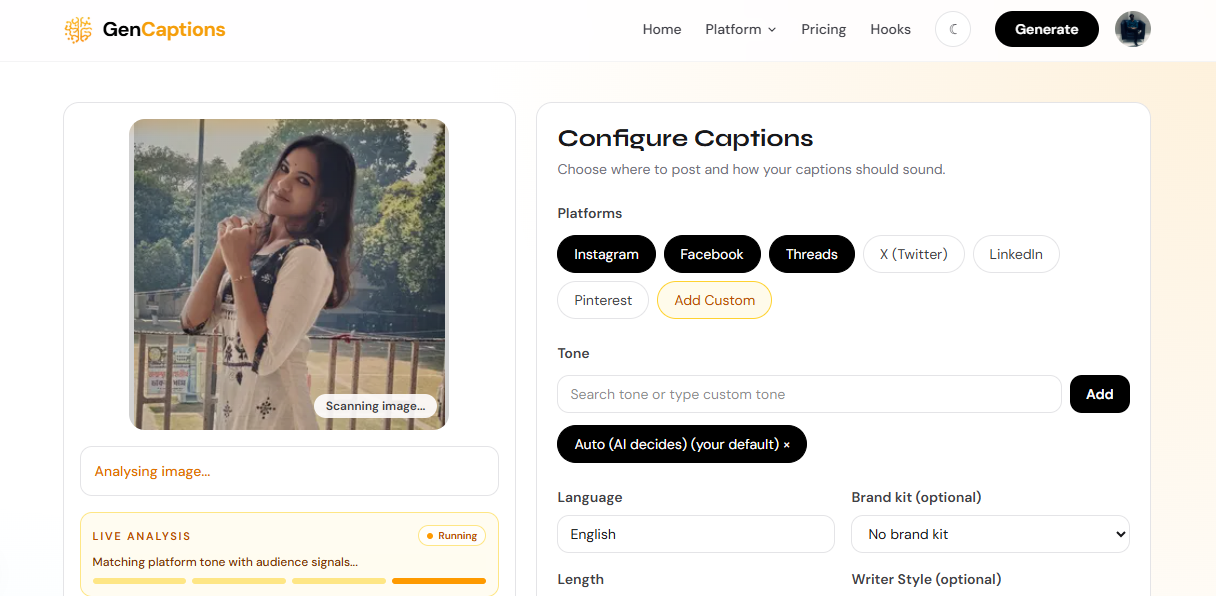
Step 2 — Select Your Tone Before Every Generate
Once your brand voice is defined, apply it every single time you use GenCaptions. The tone selector is not a one-time setting — it is a per-post decision. A product launch caption needs a different energy than a behind-the-scenes caption, even if the brand voice stays the same. Selecting the right tone before you generate is what keeps output feeling consistent and intentional.
The Biggest Mistake Brands Make With AI Content
The most common AI content mistake is treating every generated caption as a finished product. It is not. It is a first draft — a very fast, very good first draft.
The brands that sound robotic online are the ones who copy-paste without reading. The brands that sound human are the ones who generate, then spend 30 seconds adjusting one sentence, swapping one word, adding one detail only they would know.
A simple three-step edit process after every generate:
- Read it aloud. If it sounds like you, it is ready. If it sounds like a newsletter, fix it.
- Add one specific detail. A product name, a real number, a reference your audience will recognise. Specificity is what makes AI copy feel human.
- Check the CTA. Generic CTAs like "check the link in bio" can almost always be sharpened into something more compelling and on-brand.
Brand Voice Across Multiple Platforms
Your brand voice stays the same across platforms — but the way it expresses itself adapts. Think of it like how you speak differently at a work meeting versus dinner with friends. Same personality, different register.
- Instagram: Visual-first. Captions support the image. Voice can be fuller and more narrative.
- Threads: Text-first. Voice needs to carry the whole post. More raw, more conversational.
- LinkedIn: Professional context. Same brand personality, but with more depth and less slang.
- Twitter / X: Punchy and fast. Every word earns its place. Wit and brevity win.
- Pinterest: Aspirational and keyword-rich. Captions describe the outcome or the feeling.
Managing a consistent brand voice across all these platforms is a real operational challenge — especially for growing teams. If you need strategic support building and maintaining brand voice at scale, Whatznot helps brands develop content systems that keep every post on-voice, no matter who is writing it.
Building a Brand Voice Document Your AI Can Use
Once you have defined your voice, write it down in a short document you can paste into any AI tool as context. Here is a simple template:
Brand name: [Your brand]
Niche: [What you do / sell]
Audience: [Who you are talking to]
Voice adjectives: [3 words — e.g. bold, warm, direct]
We always: [e.g. use short sentences, start with a question, end with a CTA]
We never: [e.g. use corporate jargon, use exclamation points, sound salesy]
Paste this before your prompt every time. The output quality difference is immediate.
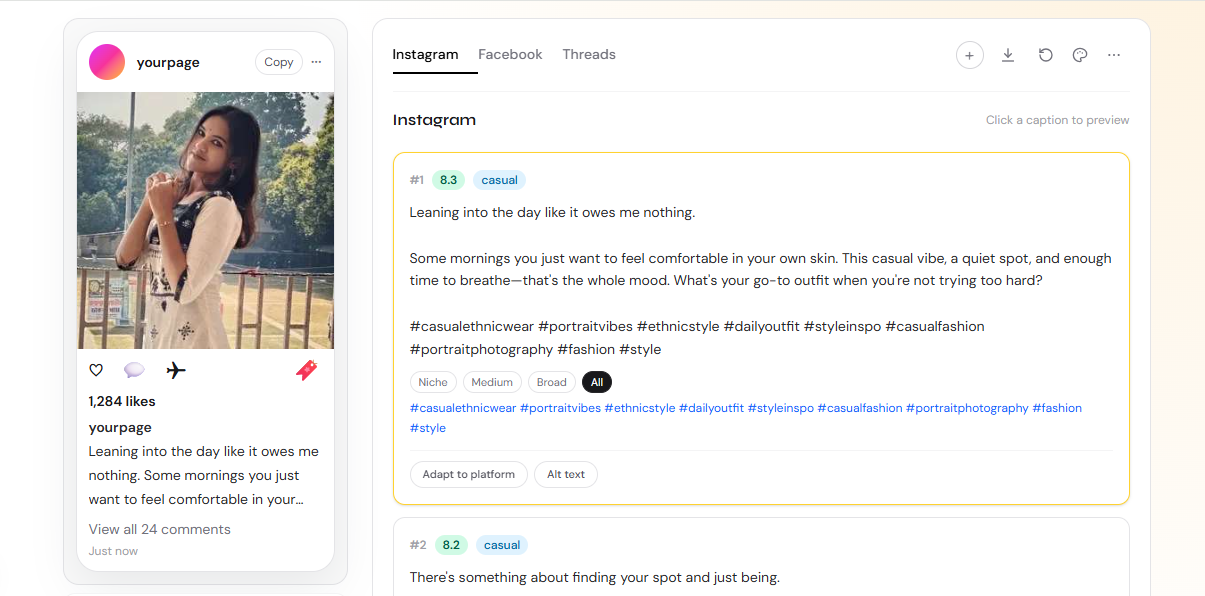
Step 3 — Copy, Post, and Stay Consistent
Consistency is not about posting every single day. It is about sounding the same person every time you do post. GenCaptions.com makes it easy to maintain that consistency at speed — generate on-brand captions for every platform, every post type, without starting from scratch each time.
Your Brand Voice Is Your Competitive Moat
Anyone can copy your content pillars. Anyone can replicate your posting schedule. Nobody can copy how you sound — if you are deliberate about it.
Define your three voice adjectives today. Write down what you never say. Run your next five captions through that filter. Then let GenCaptions.com do the heavy lifting while you focus on the strategy behind it.
Your audience will notice the difference — even if they cannot explain why. Try GenCaptions free today.
About this article
This guide is part of the GenCaptions editorial library focused on better hooks, stronger positioning, and faster caption workflows for modern social teams.